As healthcare rapidly transforms with cutting-edge technologies, the evolution of medical device assembly remains central to driving improvements in patient outcomes and operational efficiency. From diagnostics to surgical interventions, the mechanisms behind device creation lay the groundwork for advancements like personalized care and more innovative treatment options. Early adoption of advanced device techniques—such as those offered by Viant Medical Devices—is enabling organizations to stay ahead in fostering innovation, safety, and precision. These advances are not only revolutionizing the industry today but are also setting the stage for an interconnected and responsive healthcare ecosystem in the future.
Physicians, patients, and healthcare administrators alike benefit as new technologies make devices more reliable and adaptable. Leveraging state-of-the-art manufacturing practices, the medical industry is now well-positioned to meet the unique needs of patients with customized solutions, data-driven insights, and unprecedented speed. As global health challenges become increasingly complex, the role of streamlined device assembly in supporting clinical efficiency and care quality can’t be overstated.
AI Integration in Medical Devices
Artificial Intelligence (AI) is redefining medical devices, enabling high-performance data analysis and facilitating predictive diagnostics at an unprecedented scale. Through AI algorithms, medical professionals can process complex data—including imaging, biosignal, and patient history—much faster than ever before. For instance, AI-powered digital stethoscopes not only amplify sound but also leverage machine learning to distinguish between various cardiovascular anomalies, thereby significantly increasing the likelihood of early detection and intervention. The result is care that is more personalized, accurate, and timely.
Beyond diagnostics, AI is making inroads into remote patient monitoring and smart therapeutics, adapting treatments to patient-specific trends and responses. This dynamic adaptability underscores the broader potential of AI in ensuring safety, reducing errors, and optimizing clinical pathways. Institutions such as the Mayo Clinic are actively exploring ways to integrate machine learning and AI into frontline clinical practice, underscoring the promise these tools hold for transforming patient care.
Robotics Enhancing Surgical Precision
The integration of robotics in surgical suites has emerged as one of the most profound shifts within modern healthcare delivery. Robotic surgical systems provide surgeons with enhanced dexterity, steady control, and magnified visualization, outpacing the limitations of human hands. These advancements result in minimally invasive procedures, meaning smaller incisions, reduced pain, and significantly shorter recovery times for patients. Such technologies have expanded the reach of complex surgeries even in remote locations, democratizing access to high-quality care.
Robots are also being incorporated into postoperative care and rehabilitation, automating repetitive tasks and providing precise, data-driven support to medical staff. As robots continue to learn from thousands of cases, their role in clinical decision-making will only expand, further optimizing surgical outcomes.
3D Printing Revolutionizing Device Manufacturing
3D printing is ushering in a new era of device customization and rapid prototyping in the healthcare sector. Unlike traditional manufacturing, which often relies on standardized sizes and mass production, 3D printing enables the creation of custom implants, prosthetics, and surgical tools tailored to each patient’s unique anatomy. This not only improves device compatibility but also enhances patient comfort and postoperative outcomes.
The flexibility afforded by 3D technology enables device prototypes to be refined and tested in real-time, drastically shortening product development cycles. The market for 3D-printed medical devices is rapidly growing, spurred by innovative applications in areas such as orthopedics, dental implants, and even bio-printed tissues. Research leaders, such as those at Johns Hopkins Medicine, note that the applications of 3D printing in healthcare are continually expanding, paving the way for more affordable and accessible custom solutions.
IoT and Smart Sensors in Patient Monitoring
The adoption of the Internet of Things (IoT) and smart sensors in healthcare is fueling a paradigm shift toward proactive and preventive medicine. Wearable devices equipped with interconnected sensors can continuously monitor a patient’s vitals, providing real-time health updates directly to clinicians and caregivers. This constant data exchange enables healthcare professionals to identify early warning signs, facilitating swift and targeted interventions, particularly in the management of chronic care.
Beyond remote monitoring, IoT has paved the way for seamless integration of medical equipment within hospital networks. When devices and tools are integrated into a digital ecosystem, healthcare providers can minimize errors, automate routine maintenance, and streamline inventory management—resulting in operational savings and improved patient outcomes.
Digitalization and Industry 4.0 in Healthcare
Healthcare is embracing digital transformation and Industry 4.0 principles by creating intelligent, data-driven systems that interconnect devices, facilities, and providers. Through digital twins, cloud computing, and predictive analytics, health systems can now monitor equipment status, forecast maintenance requirements, and optimize production processes for maximal efficiency. This interconnectedness not only supports proactive patient care but also streamlines regulatory compliance, traceability, and quality assurance throughout the device manufacturing lifecycle.
As a result, manufacturers can respond swiftly to fluctuations in market demand, regulatory changes, and technological advancements, while maintaining a focus on patient safety and operational agility.
Collaborative Robots in Medical Assembly
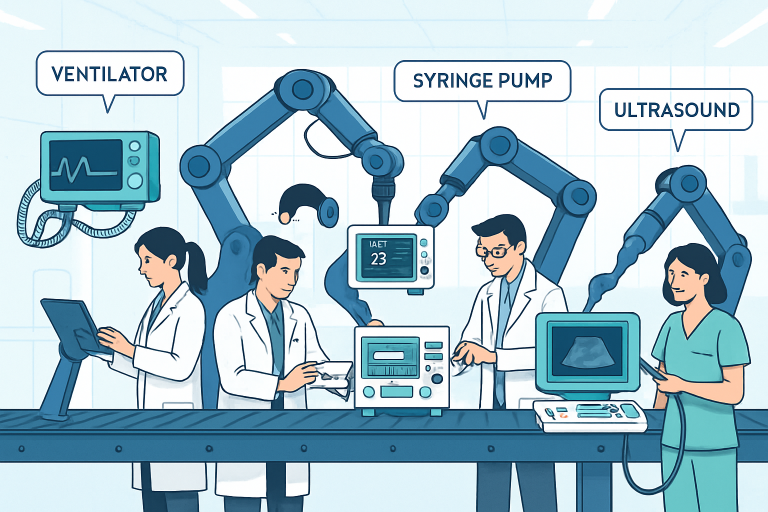
Collaborative robots, or cobots, have revolutionized the medical device assembly floor by working alongside human technicians. Unlike traditional industrial robots that operate in isolation, cobots utilize sensors and AI-powered navigation to support human workers in precise and repetitive manufacturing tasks with seamless efficiency. This collaboration enables consistent quality, reduces defects, and facilitates adaptability to production changes.
As cobots take on routine assembly work, human technicians are freed to focus on higher-value and complex responsibilities, such as quality assurance, system calibration, and innovation. This synergy fosters productivity, job satisfaction, and safety—an optimal blend for ongoing technological advancement and workforce empowerment.
Future Outlook
The future of healthcare is deeply connected to rapid progress in medical device assembly, where cutting-edge technologies are transforming the way care is delivered. Innovations in AI, robotics, 3D printing, and IoT are enabling smarter, more precise devices tailored to individual patient needs. These tools support faster diagnostics, minimally invasive treatments, and real-time monitoring, ultimately improving outcomes and efficiency. For hospitals and manufacturers, adopting these advancements means creating care models that are more adaptive, data-driven, and patient-centric. Organizations that invest in these technologies will be better positioned to lead the industry and provide truly transformative care on a global scale.